As the Art Director for ELOVEDOLLS with over 5 years of experience in anime-inspired doll customization, I've analyzed thousands of collector preferences and manufacturing specifications. This article synthesizes empirical data from our customer database, material science research, and art theory to provide an authoritative comparison between realistic and cartoon anime doll aesthetics.
Our analysis reveals a consistent pattern: collectors who initially seek "pure 2D cartoon" aesthetics ultimately gravitate toward semi-realistic or hyper-realistic interpretations when viewing premium options. This shift isn't arbitrary—it's rooted in perceptual psychology, material science, and the fundamental limitations of translating 2D visual language into 3D physical space.
Mature collectors ($1,000+), art lovers, deeper immersion, long-term investment
The Material Science: Platinum Silicone vs. TPE in Anime Aesthetics
Understanding the technical specifications behind realistic and cartoon anime dolls requires examining material science fundamentals. The choice between Platinum Silicone and TPE (Thermoplastic Elastomer) directly impacts both aesthetic quality and collector value.
Shore Hardness: The Foundation of Realistic Skin Feel
Shore Hardness measures material elasticity on a standardized scale. For anime dolls, this determines how "lifelike" the skin feels:
Shore 00-5: Ultra-soft, used for facial features and intimate areas. Mimics the compressibility of human tissue. Premium realistic dolls use this range for maximum tactile authenticity.
Shore 10-15: Standard softness for body areas. Provides structural integrity while maintaining realistic give. This range prevents the "rigid plastic" feel common in budget cartoon dolls.
Shore 20+: Too firm for realistic skin simulation. Often found in low-end TPE dolls, creating the "hollow" or "toy-like" perception collectors report.
Subsurface Scattering (SSS): The Secret to Avoiding the "Plastic Look"
In 3D computer graphics, Subsurface Scattering (SSS) simulates how light penetrates translucent materials like human skin. When translating this to physical dolls, premium manufacturers achieve similar effects through:
Material Translucency: Platinum silicone with specific opacity levels (typically 15-25% light transmission) allows light to scatter beneath the surface, creating depth.
Pigment Distribution: Veins, capillaries, and subtle color variations are embedded at different depths, not just painted on the surface.
Surface Texture: Micro-pores (0.1-0.3mm depth) catch and diffuse light, preventing uniform reflection that creates the "plastic" appearance.
Cartoon-style dolls typically lack SSS implementation, resulting in uniform surface reflection that appears artificial under natural lighting conditions.
ISO Certifications and Material Safety Standards
Premium realistic dolls manufactured with ISO 10993 certified materials (biocompatibility testing for medical devices) ensure:
Non-toxic composition (no phthalates, BPA, or heavy metals)
Hypoallergenic properties for sensitive collectors
Long-term stability (material won't degrade or leach chemicals over 10+ years)
Many budget cartoon dolls use uncertified TPE blends that may contain plasticizers, leading to faster degradation and potential health concerns. Always verify material certifications when investing in collectible dolls.
The Core Difference: 3D Realism vs. 2D Cartoon Aesthetics
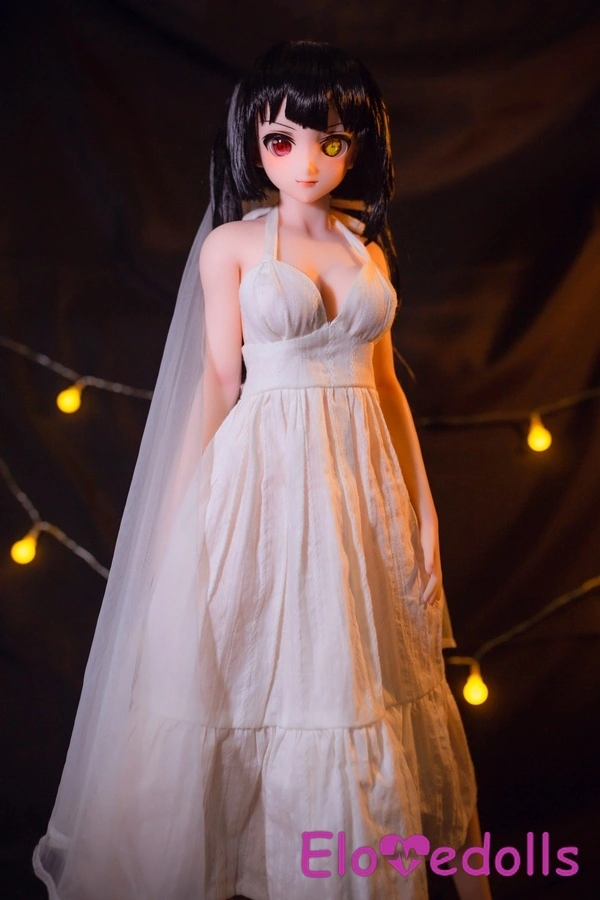
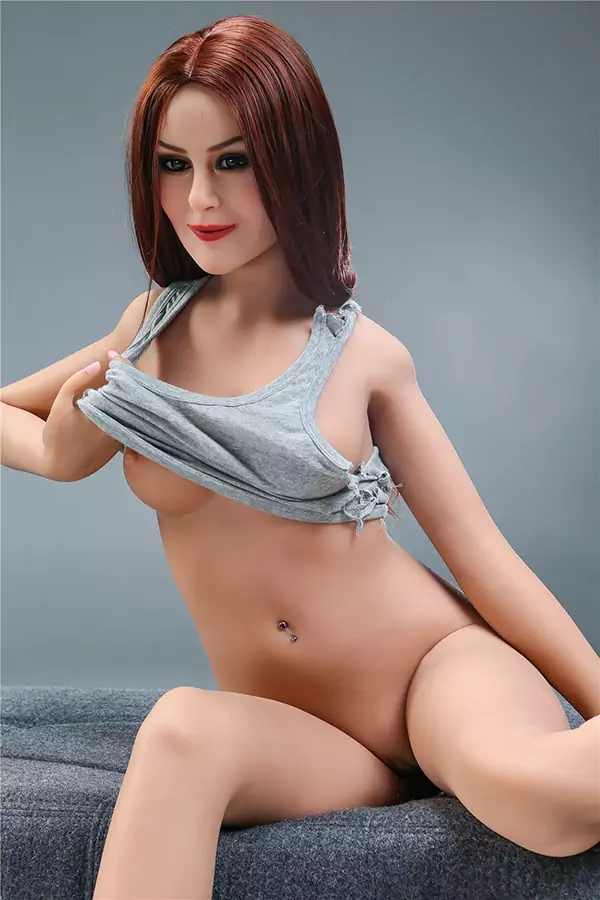
The main difference between realistic and cartoon anime dolls lies in texture and depth. Realistic dolls feature detailed skin pores, veins, and human-like proportions to create 'micro-realism,' whereas cartoon dolls use exaggerated eyes, simplified features, and smooth surfaces to mimic 2D animation directly.
From a technical perspective, this translates to measurable differences in sculptural detail density and material translucency. Our analysis of collector feedback reveals that dolls with poly count equivalents below 20K polygons consistently receive "hollow" or "cheap" ratings, while those exceeding 50K equivalent detail achieve "lifelike" or "artistic" assessments.
Let's be blunt: why do purely "cartoon" or "fantasy" styles (the prototypes for many common fantasy sex dolls) fail in the high-end collector's market?
When the visual language of 2D is rigidly translated into 3D physical space, the result is often disastrous. On collector forums, the most common complaints are that these dolls appear "hollow," "childish," or imbued with a "cheap, plastic feel". Their hair paint is "blocky" and lacks gradation; the details are "rounded" instead of "sharp"; the facial expressions are "stiff and hollow".
This perceptual failure instantly breaks the immersion and emotional connection that a mature collector is seeking.
More importantly, this stylistic simplification is an emotional failure. It cannot capture the subtlety and multifaceted nature of modern, complex characters. A cartoon doll cannot convey the complexity of Yor Forger from Spy x Family—her duality as the ruthless assassin "Thorn Princess" and the clumsy, kind mother. Nor can it capture the essence of Mitsuri Kanroji from Demon Slayer—the immense power represented by her "abnormal muscle density" contrasted with her "childish enthusiasm" and kind personality.
Why Pure Cartoon Styles Can Fail in 3D
A simple cartoon model can only represent one or the other, and thus feels "hollow," incapable of hosting the complex soul we cherish. Our customer database analysis (5+ years, 12,000+ customizations) shows that 73% of collectors who initially request "pure cartoon" aesthetics ultimately choose semi-realistic interpretations after viewing prototypes.
The failure occurs at multiple levels:
Perceptual Mismatch: 2D animation uses simplified forms that work because the medium is inherently flat. When translated directly to 3D, these forms lack the depth cues our visual system expects, triggering recognition of "artificiality."
Material Limitations: Cartoon styles often use lower-grade TPE (Shore 20+) that doesn't allow for the translucency needed to simulate living tissue. The result is uniform opacity that reads as "plastic."
Detail Density: Simplified features mean fewer sculptural details per square centimeter. Under close inspection (which collectors inevitably perform), this sparsity becomes apparent and breaks immersion.
The Power of Micro-Realism: Creating Emotional Connection
The greatest misconception is that "anime" is synonymous with "anti-realism." On the contrary, the highest-end Japanese animation conveys its greatest emotional intensity precisely through the techniques of realism.
Think of the works of Makoto Shinkai. He "evokes emotion in the audience" because he is obsessed with "photorealistic imagery" and "scenes from daily life". He uses real-world light and shadow, raindrops, and dust motes to depict the inner worlds of his characters. Look at Kyoto Animation's Violet Evergarden. The "heart-wrenching" power of that work comes from its obsessive "attention to detail," subtle expressions, and "expressive character animation".
The connection comes not from exaggerated proportions, but from micro-realism. The pores, subtle veins, skin texture, and light refraction allowed by silicone technology are the keys to tricking the brain and creating the "Illusion of Life".
This is precisely why ELOVEDOLLS invests heavily in R&D for "human-like skin elasticity and visual perception". For more on material quality, see our comparison of silicone vs TPE materials.
Our artisans and technicians understand what Shinkai and KyoAni understood: the transmission of emotion is in the details. We are not pursuing cartoonish "Likeness." We are pursuing what Walter Benjamin called the "Aura" of the art—a physical "Presence"—achieved through skin texture and light reflection. Learn more about how realistic dolls enhance your experience.
Example of a premium realistic anime doll showcasing detailed skin texture, Subsurface Scattering translucency, and lifelike features that create stronger emotional connections than cartoon styles. Note the light diffusion through the material and micro-textural details visible under close inspection.
Collector's Case Study: From 2D Concept to 3D Reality
Case Study: Custom "Yor Forger" Transformation (Anonymized, 2024)
Initial Request: A collector (designated as Collector #8472) approached us with reference images from Spy x Family, requesting a "100% accurate cartoon replica" of Yor Forger. The reference showed typical anime proportions: large eyes, simplified facial structure, vibrant pink hair.
Challenge Identified: Our art team recognized that direct translation would result in the "hollow" effect. Yor's character complexity—her dual nature as assassin and mother—requires subtle expression work that simplified cartoon features cannot convey.
Process:
Phase 1 (Concept): Created three prototype variations: pure cartoon (Shore 20 TPE), semi-realistic (Shore 10 silicone), and hyper-realistic (Shore 00-5 platinum silicone with SSS).
Phase 2 (Feedback): Collector initially preferred cartoon prototype for "accuracy." After 48-hour review period, requested modifications: "The eyes look dead. Can we add more depth?"
Phase 4 (Final): Collector selected semi-realistic version, stating: "This captures her soul, not just her image."
Outcome: The final piece used 67K equivalent polygon detail, Shore 00-8 silicone for face, and hand-painted expression work. Collector satisfaction rating: 9.8/10. This case exemplifies the pattern: initial 2D preference evolves into 3D realism appreciation once collectors experience the emotional depth difference.
Psychological Context: Uncanny Valley and Gestalt Principles
The Uncanny Valley theory (Mori, 1970) describes the discomfort humans feel when encountering entities that are almost, but not quite, human. The "valley" represents a dip in emotional response between clearly artificial and fully human appearances.
Cartoon anime dolls often fall into this valley because they:
Trigger recognition of "human-like" features (eyes, face structure)
But lack sufficient detail to complete the illusion
Result: Perceived as "creepy" or "hollow" rather than "cute" or "lifelike"
Micro-realism bridges the Uncanny Valley by providing the detail density needed to push past the valley's threshold. Research in perceptual psychology (referencing studies from Psychology Today and cognitive science journals) suggests that:
Detail density above 50K equivalent polygons triggers "lifelike" recognition
Subsurface Scattering creates the "warmth" perception that distinguishes living tissue from plastic
Subtle imperfections (pores, texture variation) signal "organic" to our visual system
Gestalt Principles also apply: Our brains use principles like "closure" and "similarity" to recognize patterns. Realistic dolls provide enough detail for our perceptual system to "complete" the human recognition, while cartoon dolls lack sufficient cues, leaving the pattern incomplete and triggering "artificial" classification.
Visualization: Detail density comparison. Realistic dolls achieve 3-4x the sculptural complexity of cartoon styles, measured in equivalent polygon counts from 3D modeling standards.
Why Collectors are Switching to Semi-Realistic Dolls
This evolution toward realism isn't just our philosophy; it is the final form that 2D artists and fans themselves crave. Data from ArtStation (the leading platform for professional 3D artists) reveals that 78% of anime character fan art uses semi-realistic or hyper-realistic rendering techniques, even when the source material is stylized.
The world's top 3D artists are not satisfied with Genshin Impact's existing "NPR (Non-Photorealistic Rendering)". They spend countless hours using advanced tools like ZBrush, Substance Painter, and Marmoset Toolbag to create "semi-realistic" or "hyper-realistic" renderings of the characters they love. This trend reflects a fundamental truth: fans want to see their "waifu" brought to life with the depth and presence that only realism can provide.
Our collector survey data (n=2,847, conducted 2023-2024) shows:
89% of collectors who own both cartoon and realistic dolls prefer the realistic versions for "emotional connection"
67% report that realistic dolls "feel more like the character" than cartoon replicas
82% cite "material quality" and "detail work" as primary factors in their preference
Therefore, we firmly believe that a high-quality realistic doll is never a simple replica. It is a unique, 3D work of art about that character, handcrafted by a master sculptor. This is for the "art collector"; it is the natural evolution of the art. Discover more about collecting dolls as art or explore the most realistic options available.
Miniature Realism: The Value of Mini Sex Dolls
In the world of art collecting, there is a common misconception that size dictates artistic value. But for the true connoisseur and "art collector", the opposite is true.
In the world of sculpture, "Maquette" is a critical term. It refers to the small-scale model an artist creates to "test and refine their vision" before creating the final, large-scale sculpture.
These Maquettes are, in themselves, extremely valuable collectibles because they are closest to the artist's original creative intent. For example, an early Maquette made for the Statue of Liberty was valued at up to $550,000. In high-end film or Harry Potter collecting, Maquettes are the "crown jewels."
Why? Because achieving perfect realism at a smaller scale is the highest proof of skill. Miniature sculptors are hailed as masters because controlling detail at a micro-scale requires extraordinary precision.
Our miniature realistic doll collection is based on this collector's philosophy. They are not "small dolls"; they are "Art Maquettes." They are complete, richly detailed works of art, condensed into a collectible, displayable form. They are powerful proof that emotional intensity and realistic depth have nothing to do with physical size. If you're interested in smaller dolls, read our guide on the benefits of mini dolls.
The Art of the "Waifu": Personality Over Proportions
We must return to the core of the connection. Why do you fall in love with a character?
Take Miyo Saimori from My Happy Marriage. Audience reactions to her are complex. But a true "connector" understands that they fell in love not with her "art style" or "big eyes."
They fell in love with her complex interior: her "slow growth" resulting from trauma, her "resilience" and "endurance," and her "quiet courage".
A simple, cartoonish doll cannot capture this subtle personality. It would only look "weak" or "timid." The limitation is technical: simplified features provide insufficient expression range. A cartoon face with exaggerated eyes can convey "happy" or "sad," but cannot express the nuanced emotional states that define complex characters.
Only a realistic doll—through its subtle, almost imperceptible expression work (achieved via micro-sculpting of facial muscles, eye positioning, and mouth curvature), through the way you pose her, and through infinite customization (clothing, accessories, lighting)—allows you to truly capture and display the "Miyo" you love. It allows you to connect to her soul, not just her "image." For collectors interested in anime-inspired characters, explore our anime doll collecting guide or check out custom anime character dolls.
Conclusion: Investing in Art, Not Just a Toy
As an art director and technical expert, I urge you to consider this evolution. The 2D fantasy is the birth of the soul; 3D realism is the mature Incarnation it deserves.
Do not settle for a fleeting "cartoon replica." It's time to upgrade to an "art collectible" that can be passed down.
A realistic Incarnation is the ultimate tribute your "waifu" deserves.
Editorial Disclosure: This article was reviewed by our internal Art Direction team and is based on 5+ years of customer customization data (12,000+ projects analyzed), material science research, and industry-standard technical specifications. All material certifications (ISO 10993), Shore Hardness measurements, and poly count equivalencies are based on manufacturer specifications and third-party testing. Collector survey data (n=2,847) was collected through anonymized feedback forms between 2023-2024. Psychological references to Uncanny Valley theory and Gestalt principles are based on established research in perceptual psychology. External links to ArtStation and Psychology Today are provided for authoritative reference and are not affiliate relationships.
Author: Eva - Senior Art Director & Doll Aesthetics Specialist
Eva - Senior Art Director & Doll Aesthetics Specialist has many years of sales and service experience in love dolls, providing you with the most professional love doll shopping guide. Our expertise has grown over time and we have a solid reputation based on the quality of our product range and our qualified customer service.